Getting older?
Recognise the signs
Getting older?
Recognise the signs
Do you ever wonder whether your horse could now be classed as an ‘old horse’? Or whether there are any things you should be adjusting because of his age? There are signs which will help you recognise that your horse is getting ‘old’. It’s important to recognise these, as responding to these signs in time will help prevent a general decline in his health.
Do you ever wonder whether your horse could now be classed as an ‘old horse’? Or whether there are any things you should be adjusting because of his age? There are signs which will help you recognise that your horse is getting ‘old’. It’s important to recognise these, as responding to these signs in time will help prevent a general decline in his health.
A short checklist
My horse:
- Is 18+
- Is becoming slower during training
- Is displaying different behaviour
- Has descended in rank in the herd
- Has difficulty shedding
- Has hollow dimples above his eyes
- Has grey hair on his head
- Has a slightly sagging back
- Is more susceptible to diseases, has reduced resistance
- Has lost weight without any apparent medical reason
- Is not eating well, is creating ‘clumps‘
If one of more of these things apply to your horse without a medical reason and your horse is of a certain age, then you would be well advised to check whether there are any things you need to adjust where your nutrition or management are concerned. Your horse is becoming a ‘senior’.
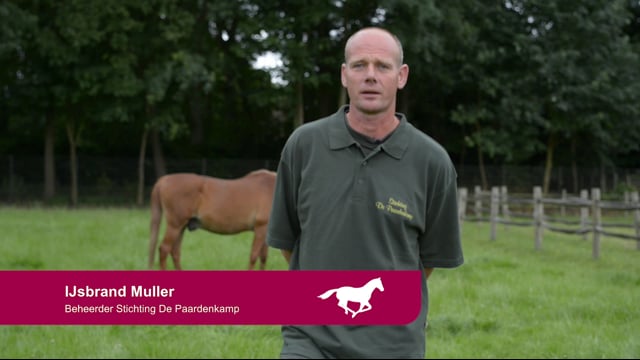

“Some horses will age faster than others. One horse will reach proper retirement by the time he turns 20, whilst another can still be ridden as much as in his earlier years”
Harrit van der Meer, veterinarian De Paardenkamp
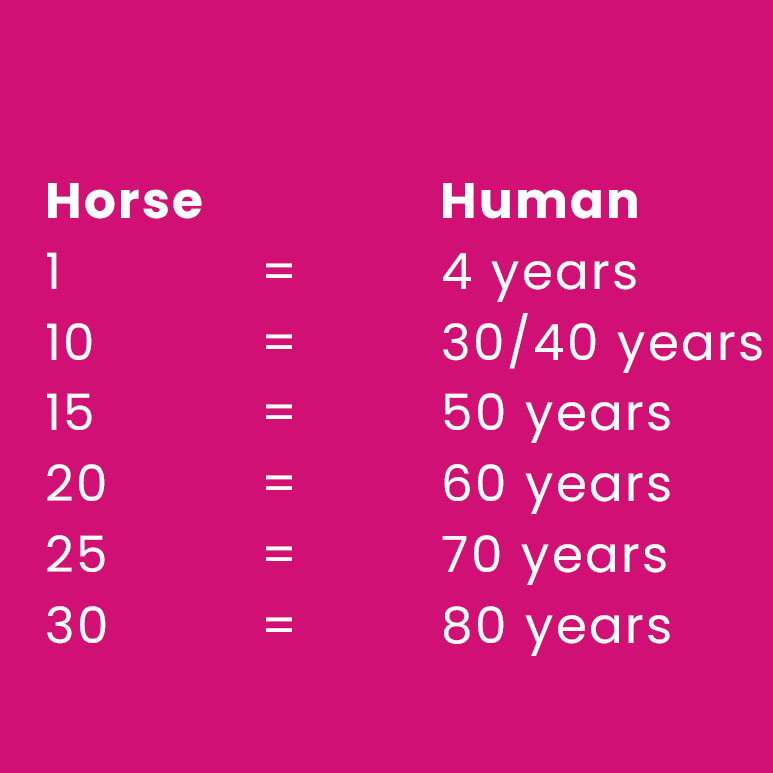
How old is your horse in human years?
Do you actually know how old your horse is when you compare it to human years? You’ll find a comparison in the following table.
What will be changing?
As horses age, their digestive efficiency gradually decreases: nutrients are less absorbed and the microbial population in the hindgut decreases. As a result, the old horse can use less nutrients from the same amount of feed. Besides a decreased digestive efficiency, the dental condition of the old horse is also often decreasing. This can results in an impaired ability of chewing and therefore digesting feed properly.
Older horses often loose muscle mass and body condition easily, which increases their requirement for more (and high-quality) easy digestible protein - sometimes approaching that of a growing horse. The energy requirement can also rise, as they use feed nutrients less efficiently and need more energy to maintain body temperature and condition. However, at the same time, the digestion of sugars and starches is less efficient in older horses.. Therefore, it is advisable to limit these components and rely more on sources as easy digestible fats and fibres, safe sources that still provide sufficient energy for their increased demand. The sensitivity to sugar and starches varies per old horse, therefore it is important to adapt their diet to their metabolic state. For example horses with PPID of insulin dysregulation, may require a diet (very) low in sugar and starch.
Metabolic efficiency also declines over time: waste products from normal body processes are broken down less efficiently, and oxidative stress increases. For that reason, old horses benefit from additional powerful antioxidants in their rations (Vitamin E, Vitamin C, Selenium and natural antioxidants like polyphenols). These antioxidants help to protect cells in the body from damage, and besides support immune function.
Both the roughage and the concentrate will need to be adjusted in line with your older horse’s needs, not only in quantity, but also in composition. You need to come up with a tailor-made solution in order to put together a good ration for your older horse.
Your horse’s dental functionforms a very important part of this. You can read more about this further on in the special.